

Introduction
In the complicated field of chemistry, seemingly simple compounds often hold critical importance across industries, research, and biology. A wonderful example is the trio of HCOOH CH2 H2O better known as formic acid, methylene groups, and water, whose chemical interplay forms the foundation of various organic reactions and industrial applications.
If you’ve come across the combination HCOOH CH2 H2O in academic research or experimental setups, you’re likely curious about their individual behaviors and collective significance. This guide, written for curious minds and professionals alike, explores the molecular structure, reactivity, use cases, and interaction patterns between these compounds, all backed by the latest 2025 data and aligned with modern chemical research.
Whether you’re a student, chemical engineer, or industry analyst, this article will equip you with both foundational and advanced knowledge, clearly and accessibly structured, with visual aids, tables, and expert commentary throughout.
What is HCOOH CH2 H2O
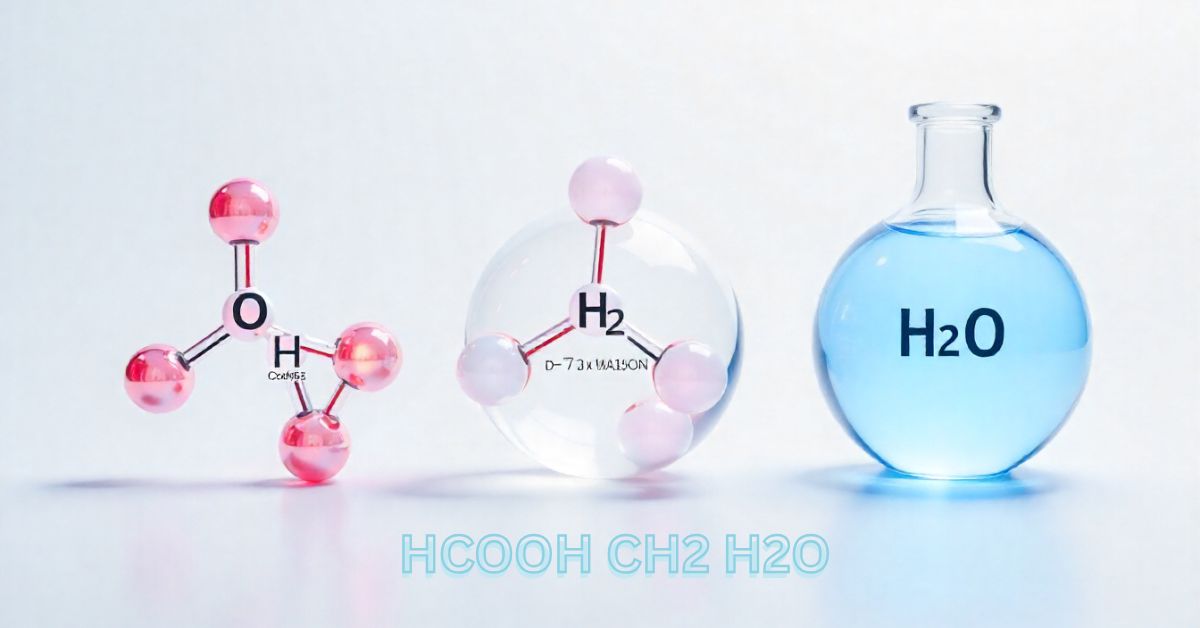
The compounds represented by HCOOH CH2 H2O are more than chemical notations. Together, they offer useful information about reaction intermediates, solvent behavior, and functional group reactivity.
- HCOOH (formic acid): The simplest carboxylic acid, commonly found in ant venom and used in synthetic industries.
- CH₂ (methylene group): A pivotal intermediate in organic reactions, particularly in carbene chemistry.
- H₂O (water): The universal solvent, critical in virtually all biochemical and industrial processes.
While these compounds are studied individually, their combined presence is frequently observed in chemical mixtures, catalytic cycles, and organic syntheses.
Molecular Composition and Bonding Behavior
Understanding the atomic makeup of each compound is essential to any chemical inquiry. Let’s analyze them one by one:
| Compound | Molecular Formula | Molar Mass (g/mol) | Bond Type |
| Formic Acid | HCOOH | 46.03 | Polar Covalent |
| Methylene | CH₂ | 14.03 | Divalent Radical |
| Water | H₂O | 18.02 | Polar Covalent |
Bonding Characteristics
- Formic Acid (HCOOH): Contains a carboxylic group where the hydrogen forms hydrogen bonds, contributing to high polarity and acidity.
- Methylene (CH₂): As a divalent molecule, it often exists in reactive intermediates (carbenes).
- Water (H₂O): Has a bent structure with a 104.5° bond angle, excellent for solvation and hydrogen bonding.
These bonding properties influence their behavior in mixtures or reactions, often determining pathway selectivity or heat release.
Physical and Chemical Properties
Knowing the properties of these compounds helps predict performance under various conditions.
| Property | Formic Acid (HCOOH) | Methylene (CH₂) | Water (H₂O) |
| State at STP | Liquid | Gas (intermediate) | Liquid |
| Boiling Point (°C) | 100.8 | Unstable intermediate | 100.0 |
| Solubility in Water | Miscible | Not stable enough | — |
| Acidity (pKa) | 3.75 | — | 15.7 |
Insights
- Formic acid is highly reactive due to its carboxylic group and low molecular complexity.
- CH₂, usually existing temporarily in a reactive state, needs a stabilizing medium.
- Water dissolves HCOOH and influences the reactivity of CH₂ in protic solvents.
Interactions Between HCOOH CH2 H2O
When combined in a reaction environment, these compounds manifest unique behaviors:
- Hydrolysis and Acid-Base Behavior: Formic acid can contribute protons in aqueous solutions, resulting in formate and hydronium.
- Carbene Insertion: CH₂ (carbene) can insert into formic acid or water molecules during catalytic cycles.
- Solvent Effects: Water moderates reaction temperatures and intermediates like CH₂ through hydrogen bonding.
These interactions are pivotal in applications like catalyst chemistry and green reactions.
Key Reactions Involving These Compounds
1. Decomposition of Formic Acid in Water
This is a common reaction in green chemistry:
HCOOH → CO + H₂O
- Catalyst: Usually acidic or metal surfaces.
- Application: Hydrogen source in fuel cells.
2. CH₂ Insertion into O-H Bonds
Reactive methylene can be inserted into the O-H bonds of water or formic acid under UV or radical conditions.
R2C=CH₂ + CH₂ (carbene) → R2C-CH2-CH2OH
3. Formylation Reactions
Using aqueous formic acid and carbene precursors, new C-C bonds are forged under solvent-controlled environments.
Industrial Use Cases
Formic Acid
- Leather treatment and tanning
- Preservation in animal feed
- Emerging hydrogen storage agent
CH₂ derivatives
- Plastic and polymer synthesis (via formaldehyde)
- Drug precursor in synthesis pathways
Combined Applications
- Formic acid-water solutions used in eco-friendly catalytic hydrogen generation.
- CH₂ intermediates used in pharmaceutical synthesis via aqueous or alcohol mediums.
Environmental and Biological Roles
- Formic acid is produced in metabolic reactions and excreted by insects like ants. It’s biodegradable and low in environmental persistence.
- Water is the carrier of many biological reactions.
- Methylene appears briefly in biological transformations but usually in regulated enzymatic processes.
These compounds represent green chemistry pathways due to their low long-term toxicity (especially formic acid and water).
Laboratory Handling and Safety Profile
Formic Acid
- Formic acid can be corrosive and irritating to the skin and eyes.
- Use gloves, safety glasses, and fume hoods.
CH₂
- The chemical is generated in situ. Handle under inert environments.
- High concentrations cause an explosive reaction.
Water
- Water is safe, but spills can interfere with electrical components.
Analytical Techniques for Study
To study these compounds and their interactions, chemists rely on:
- NMR Spectroscopy: Detects proton environments in formic acid and reaction products.
- IR Spectroscopy: Identifies functional groups like C=O and O-H.
- GC-MS: Useful in detecting low molecular weight products and intermediates.
- High-Performance Liquid Chromatography (HPLC): For quantifying formic acid in aqueous environments.
Research Trends and Future Applications
As of 2025, industries and laboratories are focusing on:
Formic Acid
- Fuel cells are being utilized as a hydrogen donor.
- The process involves the reduction of carbon dioxide.
CH₂
- Photochemical catalysts ensure a safer generation process in aqueous media.
- It plays a crucial role in the asymmetric catalysis of advanced drug synthesis.
H₂O
- It is utilized in solvent-optimized synthesis for sustainable processes.
Emerging Field
- Electrocatalytic conversion: Using formic acid and water in renewable energy storage.
Visual Comparison Chart
| Feature | HCOOH | CH₂ | H₂O |
| Common Use | Preservative, Fuel | Reactive Intermediate | Solvent, Reactant |
| Stability | Stable | Short-lived | Very Stable |
| Safety Concerns | Corrosive | Reactive | Minimal |
| Role in Green Chemistry | Yes | Yes (limited) | Yes |
FAQs
What is the significance of HCOOH CH2 H2O in chemistry?
They commonly occur together in synthesis and catalytic reactions, often in green chemistry.
Is formic acid safe to use in labs?
Yes, with proper PPE. It is corrosive but manageable.
Are methylene groups stable in nature?
No. They are short-lived and reactive, used in situ.
Can these compounds be used in hydrogen fuel generation?
Yes. Formic acid is a promising hydrogen carrier.
Are these chemicals found in biological systems?
Yes, biological systems do contain formic acid and water. Methylene is rarely free.
Conclusion
The chemical trio of HCOOH CH2 H2O represents a fascinating intersection of organic chemistry, industrial application, and green innovation. Together, formic acid’s acidity, methylene’s reactivity, and water’s universality form a toolkit essential for modern chemical engineering and sustainable research.
By understanding how these compounds behave, in isolation and combination, we unlock more efficient and cleaner chemical processes. Whether you’re exploring new catalysts, synthesizing drugs, or studying hydrogen fuels, these substances provide foundational knowledge and innovation potential.
